Why Ruta graveolens Calls for Caution
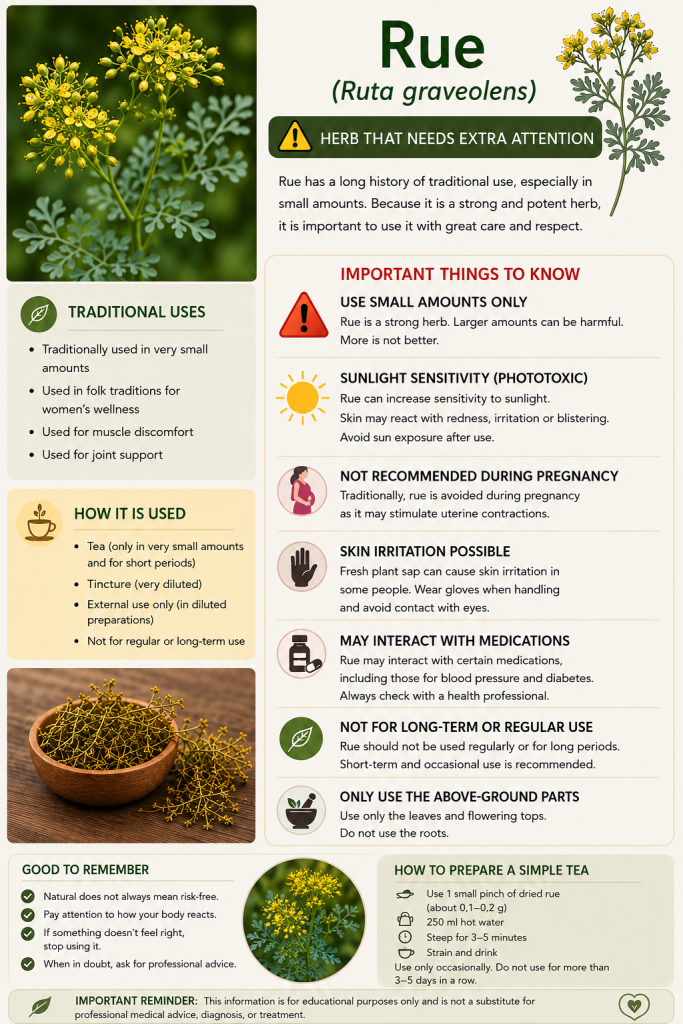
A Rue (Ruta graveolens) is one of those traditional medicinal plants that reminds us why herbal knowledge deserves both appreciation and caution. For centuries, people across the Mediterranean region and many parts of Europe have used rue in traditional practices. It appeared in household herbal traditions, gardens, folk medicine, and cultural customs. Yet unlike many gentler herbs used in everyday life, rue has long been regarded as a plant that requires respect and careful handling.
One of the most important lessons about Ruta graveolens is simple: more is not better. Traditional herbal practice often used rue only in very small amounts and for short periods. Larger quantities may increase the risk of unwanted effects. This is one reason why modern herbal guidance usually recommends extra caution when using rue preparations.
Another important point is sensitivity to sunlight. Rue contains natural compounds that may increase the skin’s sensitivity to sunlight. Scientists call this phototoxicity. In practical terms, this means that after handling fresh rue – especially in sunny weather – some people may develop redness, irritation, dark marks, or even blister-like skin reactions. Not everyone experiences this, but it is important to be aware of the possibility.
If working with fresh plants:
- wash your hands after handling;
- avoid touching your eyes or sensitive areas of skin;
- consider wearing gloves when harvesting larger amounts;
- take extra care before spending time in strong sunlight.
Fresh rue and concentrated preparations deserve particular attention.
Rue is also one of the herbs for which special caution is needed during pregnancy. Traditional herbal sources often advised avoiding rue during pregnancy because some of its active compounds may stimulate uterine activity. Modern guidance continues to recommend caution. Because safety information remains limited, professional advice is especially important during pregnancy and breastfeeding.
Another area that deserves attention is concentration and preparation method. A mild herbal preparation is not the same as a concentrated extract or essential oil. Like many aromatic plants, rue becomes much more potent in concentrated forms. Traditional herbal systems often relied on careful preparation methods and modest amounts. This is a reminder that herbal knowledge involved not only choosing the right plant, but also understanding how to use it safely.
People who take regular medication or live with long-term health conditions should also approach rue carefully. Although research on interactions is less extensive than for plants such as St John’s Wort, caution remains sensible whenever herbal preparations are combined with medicines.
Rue teaches an important lesson that appears throughout herbal traditions: powerful plants deserve thoughtful use. Traditional knowledge and modern understanding can work well together. Learning from both allows us to preserve valuable herbal heritage while making informed and responsible choices.
Sometimes wisdom is not only knowing which plant to use, but also knowing when to use less – or when not to use it at all.